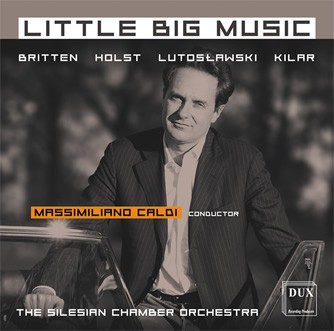
Britten Holst Lutoslawski Kilar
Benjamin Britten: Variations on the Theme of Frank Bridge
Gustaw Holst: St Paul’s Suite
Witold Lutosławski: Five Folk Tunes
Wojciech Kilar: Orawa
Massimiliano Caldi, Director
Silesian Chamber Orchestra
Dux label – Year 2009
Reviews
Amadeus, June 2009 – Luigi Di Fronzo
Little big Music: an animated play on oxymorons – like that Little Big Man movie starring in the 1970s by the legendary Dustin Hoffmann – that also in this CD operates on the wide gap of proportions and s ignifications: narrow temporal dimensions/high value of a message (in this case purely artistic and musical) even if, as it happens, the testimony draws in part on the popular and folkloric matrix of narrative materials. The signature is by one of the most vivacious (and gifted) conductors of the new generation, Milanese Massimiliano Caldi, who since 2006 has been at the helm of the already extraordinary Silesian Chamber Orchestra, a growing nucleus of Polish musical culture that has already performed on two tours through Italy. The sound of the strings is compact, yet soft, supple and flowing, the choice of tempi perfect, the understanding as an over-the-top chamber group, with musical ideas gushing joyfully and designs bouncing with perfect synchrony from one voice to another. Beautiful then is the choice of music. They range from Britten’s Variations on a Theme by Frank Bridge Op. 10 (Bridge was the composer’s first teacher)-which enunciate humorous episodes, Rossinian quotations and Ravelian assonances-to Gustav Holst’s popular St. Paul Suite, which draws heavily on Scottish and Irish folk dances, and then asserts the most genuine and authentic Polish roots with Lutoslawski’s Folk Melodies. A festive and most pleasant epigone, Orawa by contemporary Wojciech Kilar (born 1933), a brilliant mix of minimalism and peasant manners inspired by the melodies of the Tatra Mountains. Not to be missed.
onet.pl, April 2009 Katarzyna Paluch
The title of DUX label’s latest album “Little big music” refers to the small musical forms that express great artistic and emotional value in themselves. Small, does not mean simpler or less complex. Not only that, a small variation can condense into itself the methods of the symphony, which gain in dynamics. Benjamin Britten’s “Variations on a Theme of Frank Bridge” that opens the album is a good example of this. The album was prepared by conductor Massimiliano Caldi, who led the musicians of the Silesian Chamber Orchestra. In addition to Britten’s variation, the album contains Gustaw Holst’s suite, folk melodies in Witold Lutoslawski’s arrangement, and the chamber music hit: “Orawa” by Wojciech Kilar. Although Benjamin Britten’s “Variations on a Theme…” belong to his earliest compositions they are already an example of the composer’s creative talent and maturity. In the ten variations Britten encapsulated almost all musical epochs, and in addition refined orchestration was able to make the chamber ensemble a great symphony orchestra. With Caldi conducting, the sound of the Silesian Chamber Orchestra is once monumental and grave and then changes character to light and lyrical as in the string quartet. It is possible to achieve such an interesting phenomenon only with union of three elements: excellent instrumentation of the composition, interpretative talent of the conductor, and an orchestra sensitive to his directives. Gustaw Holst, on the other hand, in his “St. Paul’s Suite,” connected not so much eras but regions of the world. If we let our imagination work in the “Intermezzo” we will hear how the orchestra is transformed into a group playing the flamenco dance, where instead of hearing violins we hear castanets, and instead of the cello, Spanish singing. Like the “Finale,” it has the atmosphere and rhythm of the Italian tarantella. Lutoslawski’s compositions constitute the beginning of the disc devoted to the climate of Polish folklore. Its climax clearly constitutes the famous “Orawa,” a work in which Kilar has given vent to the fascination with the folklore of the Tatra Mountains in general, for in “Orawa” we have not only mountain rhythms and notes but also the twilight of the mountains. It is also an elegant and technically exhausting composition for the musicians (and the conductor!). The musicians of the Silesian Chamber Orchestra play this piece down to the smallest note, and this is not an easy thing to do, I say this as someone who has had the opportunity to play “Orawa.” “Little big music” represents an encounter with dynamic forms, rich in inspiration and technicalities; a journey through the history of music and some countries of the world. The choice of compositions and the perfection of execution allow one to continually discover new phenomena with each listen to the record.
Ruch muzyczny, April 19, 2009 Marianna Dabek
Massimiliano Caldi already caught my attention in the year 1999 during the VI Grzegorz Fitelberg International Competition in Katowice. He was my favorite from the first stage and the sound of the Silesian Philharmonic Orchestra conducted by him was completely different from the usual: more filled, more varied, more expressive. I still keep his interpretations in my memory. Caldi won the competition and a few years later appeared again in Katowice, this time as guest conductor of the Silesian Chamber Orchestra; since September 2006 he has been its artistic director. Since 1998 he has also served as principal conductor of the Milano Classica Chamber Orchestra. The Italian artist conducts the orchestra with an extraordinarily expressive style, characterized by exceptional energy and very suggestive and plastic gestures. He has an enormous influence on the musicians with whom he collaborates. His interpretations are full of feeling, imagination and true artistic passion. The album described represents the phonographic debut of Massimiliano Caldi and the Silesian Chamber Orchestra (the presence of an excellent Italian accordionist and bandoneonist such as Mario Stefano Pietrodarchi made the March 6, 2009 promotion concert at the Silesian Philharmonic more festive). The Britten variations that open the album emanate a variety of suggestions, feelings and expressions. An obvious and somewhat pathetic Introduction transitions fluidly to Lyrical Theme, the attenuated and tranquil Adagio contrasts with the eventful and full of impetus Marcia. After the beautiful singing of the Romanza comes the playful Italian Aria, laced with a violin theme and set against the backdrop of a pizzicato rest of the orchestra and a pathetic Bourrèe classique. The humorous-nostalgic Viennese Waltz precedes the lively Perpetual Motion. Next we have the famous Funeral March painted in a wonderfully dramatic manner, the sentimental Song and Fugue elegantly played, and the Finale that eases the tension. Massimiliano Caldi has very well composed the whole cycle in a dramaturgical manner, both from the point of view of planning the timing of narration and expression, extracting from the orchestra many, varied and interesting timbres. In the orchestra especially the dark tones sound wonderful: the violas, cellos and double bass. The whole ensemble lacks selectivity, however. Nevertheless, Britten’s work sounds interesting, showing the full range of emotions in it: from pathos through drama and lyricism to musical scherzo. Gustaw Holst’s St Paul’s Suite comes across on the album beautifully. Jig’s assertive and energetic sound contrasts with the scherzo and not without sweetness and grace Ostinato and the lyrical and very elegant Intermezzo. The Finale saturated with folk music crowns the cycle. Witold Lutoslawski’s Five Folk Melodies also play wonderfully. In this beautiful chamber work Caldi has beautifully expressed the mood of each song: from melancholy to the nostalgia of a cheerful peasant festival. The album closes with Wojciech Kilar’s Orawa performed bravuraly, with great energy and force and also with a good dramaturgical plan. The musical performers of the album should be congratulated, and the publishing house for the beautiful graphic binding (and the interesting introduction in the booklet attached to the album). The Silesian Chamber Orchestra magnificently led by Massimiliano Caldi plays really well, and I am convinced that as time goes on the artistic level will be higher and higher. It only remains to wish the orchestra and its conductor new successes.
From the monthly: “Slask” April 2009
Miedzy nutami Among the notes Magdalena Dziadek
Little Big Music is the title of the new album featuring the compositions of 20th century musicians in the performance of the Silesian Chamber Orchestra conducted by Massimiliano Caldi. The album was produced by the DUX record company with the collaboration of the Silesian Philharmonic. The conductor and musicians look very good on the album cover. The commentary written by Marek Skocz is interesting and knowledgeable, beginning with “I warmly invite you…” To such an invitation one cannot fail to respond, not least because both the very title of the disc and its musical concept are inviting. It is quite a sophisticated concept. The album contains four compositions for string orchestra by 20th century classical composers Benjamin Britten, Gustav Holst, Witold Lutoslawski and Wojciech Kilar. All four are giants of contemporary music, authors of the great works of symphonic music, for oratorio or opera. On the disc they are represented with the “smaller” but no less important works than the big ones (this philosophy is reflected in the title of the publication). “Small” also means an immersion in light, joyful, popular atmospheres. Benjamin Britten’s 1937 Variations on a Theme of Frank Bridge is a fantastic specimen of neoclassicism in its early days. Here reigns the note of a humor that is not at all British but, on the contrary, seems close to the humor of the French: Debussy, Poulenc, Eric Satie. Reflected in the series of pastiche rings from the style of classical composers are various musical characters such as marches, dances, operas and “characteristic characters” that are impossible to define (my bon mot invention to address those who are aware of the historical meaning of the term “musical character,” is a definition of genre, referring to the content, but also to the function of music: compositions that cannot be categorized in a given era were called “characteristic”) .
The second track on the album-St. Paul’s Suite by Gustaw Holst from 1913-is an unpretentious occasion composition. Holst wrote it, as the booklet accompanying the disc informs, to celebrate the completed renovation of the girls’ school where he worked. In comparison with the occasion compositions of that era, dedicated to men’s colleges, it is surprisingly graceful and natural. It seems to tell the pupils about the delights of education and after school, with language based on the characteristics of Irish and Scottish folk music. The composer seems to want to invite his pupils to dance….
Lutoslawski’s transcriptions for orchestra of five melodies that were part of the cycle Popular Melodies on the Piano (1945-46) were chosen. I played these melodies in the 1970s – then very modern: ascetic, harsh, innocent. In the orchestral version they are less modern; the assignment of the melodic voice to the strings adds romanticism to the composition, not present at all in its “original” climate. The performers still magnified this romanticism, and by continuing, provided the humble songs with unnecessary pathos. Alas! The fault lies with the composer himself who did not take into consideration the emotional aggressiveness of the musicians playing the string instruments. This aggressiveness is excellently served in Wojchciech Kilar’s Orawa (1986), which closes the album. Impulsiveness, as it is known, is a key element in the expressiveness of this composition. The orchestra entrusted to Massimiliano Caldi grasped it exceptionally well, playing the growing form of the piece with a sense of proportion and a ubiquitous “nervous” note.
This note accompanies all the interpretations on the album. The performance of the Silesian Chamber Orchestra is lively and joyful. An excellent rhythmic “ear” is present in it, there are splendid formal proportions, an interestingly planned narrative. The music presented is alive and makes listeners rejoice. The conception of the repertoire comes true in a fantastic way in this performance. It is the first album of the Silesian Chamber Orchestra edited during Caldi’s regency but immediately outstanding.
Sound direction by Malgorzata Polanska, Marcin Guza is instead the author of the digital editing. The recording was made at the headquarters of the Silesian Philharmonic.