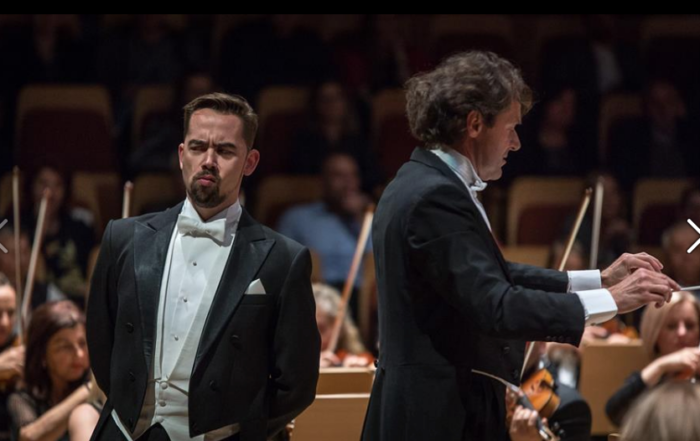
Interview with master Massimiliano Caldi
One hundred years ago the author of Mephistopheles and Nero, long and fiercely snubbed by Italian critics, died. Massimiliano Caldi: I would be happy and very willing to confront the score of Nero!
It could, perhaps should, have been the great opportunity to bring Nero back to the Italian stage. One hundred years ago, on June 10, 1918, one of the most extraordinary and interesting artists of Italy’s second half of the nineteenth century departed: Arrigo Boito, the great scapigliato, the only one of the tormented and fascinating Milanese avant-garde to have known success and affirmation, albeit after controversy and terrifying fiascos :the most sensational was precisely that of the premiere of Mefistofele at La Scala on March 5, 1868 (another missed anniversary!). But as is well known, the opera recovered and a second version of it (reduced and simplified from the first) triumphed in Bologna in 1875 and has not left the international repertory since. On the other hand, the fate of the tormented Nerone, on which the poet-musician worked for almost all his life and with particular intensity in the last decades, was different: performed posthumously in 1924, it was received with success and interest, but since the 1960s it has hardly been revived in Italy, contrary to what happened and happens abroad.
In fact, the Boitian centennial seems to be passing quietly and almost underwhelmingly. Mephistopheles is scheduled in Tokyo and New York, but apparently in no major Italian theater. An influential National Committee for the celebrations of the centenary of Arrigo Boito’s death,comprising various entities including the Cini Foundation of Venice and the Arrigo Boito Conservatory of Parma,has been formed by the Mibact. Chaired by Emilio Sala, it “promotes a busy calendar of activities aimed at enhancing the figure of the intellectual, one of the most important artists in the history of Italy”;[1] there have been a few concerts but the best way to honor this truly extraordinary artist, poet, musician, storyteller, journalist and essayist, would have been a revival of the Nerone, even in concert form.
Boito the writer and poet has been reevaluated for some time now, although some-especially certain scholastic anthologies-have not yet noticed; since Rodolfo Quadrelli’s beautiful essay Poesia e verità nel primo Boito, prefixed to an excellent Oscar Mondadori edition of the master’s literary works in 1981, the Boito bibliography has been extraordinarily enriched and the old prejudice, mainly of Crocian origin (to which must be added the Walter Binni of the poetics of Decadentism) towards Scapigliatura in general is now to be considered completely overcome. But what about the musician? As a composer Boito has been treated quite badly by much of Italian criticism; not so by foreign critics, if even George Bernard Shaw went so far as to say: One could do better without La Traviata than Mephistopheles.
Be that as it may, at least the first Boitian opera holds up well in the repertoire and has indeed recently experienced a new vitality. The best way to pay tribute to this extraordinary artist then seemed to us to be an interview with one who lives and brings music to life perhaps more than any other: a conductor.
Massimiliano Caldi (born 1967) is a very good Italian conductor who works mainly abroad. An overall winner of the “G.Fitelberg” Competition (1999), he currently serves as Principal Conductor of the Precarpathian Philharmonic “A.Malawski” in Rzeszów and First Guest Conductor of the Polish Baltic Philharmonic “F.Chopin” in Gdansk. He was a lecturer of the Florence Conducting Masterclass (2015-2017), Principal Conductor and Artistic Advisor of the Koszalin Philharmonic “S.Moniuszko” (2014-2017), Artistic Director of the Silesian Chamber Orchestra in Katowice (2006-2010) and Principal Conductor of the Milano Classica Chamber Orchestra (1998-2009).
Caldi in the past decade has undertaken tours to Israel, Oman, the United States of America, Chile, Brazil, Germany, Austria, Russia and Turkey. In the opera field, he recently conducted Rossini’s Barber of Seville, Puccini’s La Rondine and the Prologue in Heaven from Mefistofele.
Maestro, How did you discover Arrigo Boito? One hundred years after his passing, do you think he can still be relevant as a musician?
In the 1990s, still as a boy, toward the end of my music studies at the Civica Scuola di Musica in Milan (now named after Claudio Abbado), I had the good fortune to live with my parents in the historic center of Milan, just a stone’s throw from the Conservatory and La Scala, of which I was a frequent visitor, in the “golden years” of Riccardo Muti’s conducting.
As well as by so many other masterpieces then unknown to me, I was also literally thunderstruck by a concert-form performance of the “Prologue” of Mefistofele, precisely under the baton of “my” – even now – most beloved Maestro and model, namely, precisely, Riccardo Muti.
When two years ago I learned that my daughter Valentina (class of 2005) would take part, together with the White Voices of the Accademia della Scala, in the trip to the Ravenna Festival in preparation for the performance of the Prologue of “Mefistofele,” right under the baton of Riccardo Muti, I had the impression that my destiny reconnected with Boito’s masterpiece in a rather decisive way, although I had already had a small premonition about 5 years ago, when I received as a gift the precious book by Domenico Del Nero, dedicated to the great figure of Boito.
What’s more, I discovered to my surprise that my wife Adriana also loved “Mefistofele” viscerally, having heard it twice in a row at La Scala, again with Muti on the podium but-unlike me-in full and in stage form in 1995, directed by Pier’Alli and with Samuel Ramey in the role of Mefistofele.
After the mind-blowing experience of listening in Ravenna in July 2016, I told myself that the time had come to try my hand at this extraordinary and incredible score and its brilliant composer; I therefore proposed it to the Philharmonic “A. Rubinstein” in Lodz (a city of nearly a million inhabitants, south of Warsaw, the birthplace of the great Polish pianist Artur Rubinstein) for the closing of the 2016/17 season and to the Baltic Philharmonic “F. Chopin” in Gdansk, this year, for the closing of the 2017/18 season, on the occasion of the 150th anniversary of the first performance and the 100th anniversary of the composer’s death.
I am deeply convinced of the topicality of a musician like Boito! We often talk about the great topicality of so many great composers of the distant past such as Bach or such as Beethoven, and — in fact — they are, it is indisputable. However, I believe that the reasons for the topicality of a Bach and a Beethoven are given more by the fact that their much-deserved fame has never known a moment of crisis, although the genius, for example, of Bach was only decreed as such in the first half of the 19th century, almost 100 years after his death, following the first recovery and rediscovery operations by Mendelssohn.
In Boito’s case, thanks to the activities of enlightened musicians and performers such as Toscanini – then – and such as Muti, in more recent times, this composer seems to be becoming more and more relevant and, dare I say it, paradoxically more relevant today than in his time, although he has not yet achieved a high degree of popularity. Boito’s great insights and anticipations have undoubtedly influenced-for example-Wagner and Richard Strauss who, in turn, have influenced and continue to influence great composers of today such as John Williams, who is extremely popular for us today. It is precisely these fils rouges that make Boito seem extremely relevant, modern and almost familiar today, after his insights have made their way overwhelmingly through a century and a half of music history and have also come down to us thanks to the contaminations present in composers closer to us, chronologically speaking. While perhaps, in his day, his language was too “ahead” to be understood and his head and language traveled faster…than the ear of the users contemporary with him.
Although Mephistopheles is in the repertoire, on the centenary of its author’s death, performances are planned at the Metropolitan in New York, Tokyo and other theaters around the world…but at least to the knowledge of no major Italian theater. For what reason do you think? And what do you think?
I do not wish to repeat an old, sadly topical adage, but I am afraid the reason lies in the high expenditure of energy and, above all, finances required to bring to the stage (in the case of Mephistopheles) such a complex, long and articulated opera, in which, moreover, it is necessary to have a super-voice cast, a visionary and experienced director, valid choruses and a truly impressive and elaborate stage apparatus.
In Italy, unfortunately, we are still licking the wounds of the great crisis of 10 years ago that, with its “long wave,” continues to afflict most of our Italian musical institutions. Not to count then the realities where instead the expression “There is a crisis” has become a sort of watchword (fortunately, not everywhere), which is repeated for convenience but which hides, in reality, a sort of paralyzing intellectual sloth, which prevents us from getting out of the trite and rehashed repertoire although reassuring, from all points of view. Besides, the only Italian theater with a “strong” and stable artistic and musical direction for several decades is only La Scala but, at the moment, after the eras of Abbado, Muti and Barenboim, with Chailly perhaps the current stylistic orientations are a bit different, albeit very authoritative.
A “technical” judgment: what are the features of Boitian music writing that most impressed you? Is it true that at least as far as the Prologue is concerned, there are “anticipations of the twentieth century”?
If I pointed out earlier what might be considered Boito’s most immediate epigones, I might say that Boito also fits into a firm Italian tradition coming in turn from Cherubini, Ponchielli, and perhaps even, in part, Mercadante. In particular, Cherubini seems to me the composer I most instinctively associate with Boito. I think of the great choral scenes in Mefistofele or even the long First Part of the prologue with that endless series of modulations that, in the end, take us from E major to…E major, after exploring the high heavenly spheres…with a use of long harmonic turns for expressionistic and symbolic purposes.
Here, in Boito there is the continual expansion of what were the great cherubic “double choruses,” the counterpoint, the mastery in the use of harmonic procedures that modulate from one tonality to another with the use of triads in which the first and third degrees remain common to the preceding triad and only the fifth is altered, to proceed to the next tonality.
Wanting to go even further back, to the beginnings of instrumental music, the timbral and sonorous mixtures of the “bands” in Mephistopheles’ Prologue bring my ear back to the great masterpieces for brass by Andrea and Giovanni Gabrieli that Boito surely could not have failed to study and delve into.
From a less technical and more aesthetic point of view, of the Prologue (but not only) of Mephistopheles, in addition to what I have just stated, I have always been struck by that incredible sensuality of the chorus lines, particularly in the “Ave Signor.” The text is religious, the atmosphere is heavenly and everything speaks of the divine but this music sounds voluptuous and sensual, like a kind of siren song that to me, personally, is absolutely irresistible!
One possible explanation is given by the fact that these choruses may in some way already anticipate in their depths the figure of Margaret, a contradictory character, according to whom-as she herself will state in the first scene of Act II-love, life, and ecstasy are God: if this is precisely what Boito wanted to express, he has succeeded perfectly!”
As for “twentieth-century advances,” I have expressed myself before. They are there – and how! – and they constitute in my opinion precisely Boito’s cross and delight. Delight for us, listeners and performers of the twenty-first century. Cross for the audience at La Scala, from that far-off March 5, 1868, who managed to digest only one part of Mefistofele but who, judging from the chronicles of the time, lost their way at some point…
You have conducted Mefistofele (or the Prologue) on more than one occasion; what were the reactions of the orchestral players and the audience?
The audience reactions, after my recent performances of the prologue of Mephistopheles, were astounding! The comments after the concert from “fans” who flocked to the dressing room were along the lines of “But…where was this music until now…?”
The choirs (both the treble voices and, especially, the 4-voice mixed adult choirs) were always ecstatic…heavenly, conductors included.
On the other hand, I must say that the orchestras, on both occasions, despite the enthusiasm with which they approached the operation, I did not get the impression that they loved this score as much as I do. I have already proposed the Prologue a third time to “my” other Polish Philharmonic, which is the Precarpathian Philharmonic “A. Malawski” of Rzeszów (near Krakow), who, in the wake of my enthusiasm in describing the project and, given the great deployment of forces (and finances), asked me to prepare a selection of the work in concert form, not content to perform only the prologue. The pitch, in a nutshell, was this: if we have to engage so many artists all at once, why leave them on stage for only 25 minutes…?
All this will take place in fall 2019 or early 2020.
Nero is the great absentee from Italian opera stages (but not abroad); do you think a performance of it in Italy is possible? Would you like to conduct it, in Italy or abroad?
I would be happy and most willing to confront the score of the Nero!
Never more so than in these times, when audiences are now rather well versed in the “great classics,” am I less attracted to yet another direction of my own much-loved Traviata (which I would try to approach in a philological manner and which, therefore, would not be understood by the audience, much less the singers!) than to throw myself enthusiastically into such an operation.
Already in the past I have been the protagonist of recoveries of splendid titles of the 19th century that have been inexplicably shelved, such as Cagnoni’s “Don Bucefalo” and “King Lear” (at the Festival della Valle d’Itria in Martina Franca), Poniatowski’s “Pierre deMedicis” (at the Polish Music Festival in Krakow), Ferdinando Ranuzzi’s “Il Macco” (at the Guardassoni Theater in Bologna), to name a few.
I was even offered Costantino Palumbo’s “Pier Luigi Farnese” with libretto by Boito (!) a year ago but, at the moment, the operation has not yet taken off.
I often find myself abroad proposing co-productions with Italy; in the case of such an important and – in a certain sense – new title, it would really take a real “team” (and not just yours truly) working hard and, above all, adequate financial support with a main sponsor to act as a patron and shoulder most of the total cost, to also give a sort of branding to the whole operation.
Interview by Domenico Del Nero
Source : www.totalita.it