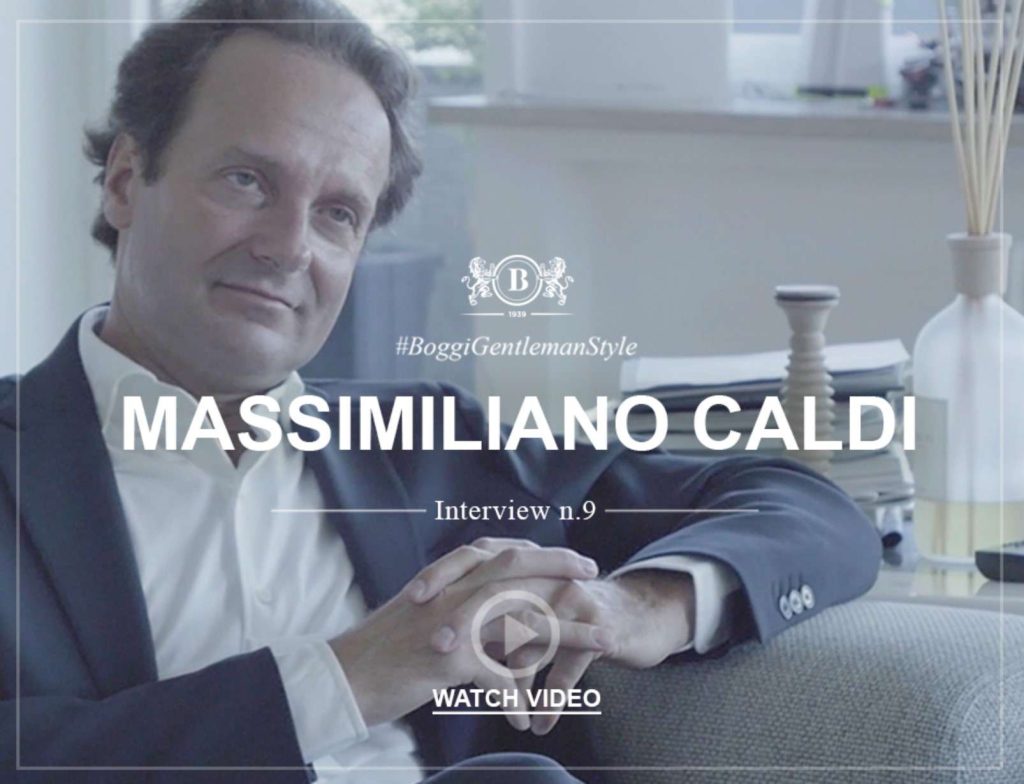
During the interview conducted at his studio in Milan, Massimiliano Caldi, conductor, tells us about his dress code, and Gentlemen in the music world.
Today we have the pleasure of meeting Massimiliano Caldi, Principal Conductor of the Rzeszów Philharmonic, Poland, and First Guest Conductor of the Polish Baltic Philharmonic in Gdansk. Massimiliano, is it really true what they say, namely that the conductor’s profession involves one’s own personal uniform? Which one do you prefer?
I favored the tailcoat. The dress code is important, whether it’s a black shirt with black pants, whether it’s also a jacket and tie, a double-breasted, but here’s a constant that then conductors always use.
What does Massimiliano Caldi look like in casual wear?
In winter long-sleeved polo shirt, in summer short-sleeved polo shirt, but blue jeans remain. I want to feel comfortable, and I always have a jacket anyway.
Boggi Milano stands out in the world for its Italian style. Is there a typically Italian interpretation of classical music as well?
For me, the Italian interpretation of classical music is Muti conducting Verdi.
Boggi Milano is faithful to the traditional canons of men’s fashion but at the same time evolves with each collection. Does the same happen with your music?
It does happen. With Toscanini and then continuing with Muti, in the history of conducting, we returned to the faithful sign as it was written by the composer, in the history of pianism for example with Michelangeli, with Pollini.
You are used to receiving applause and awards, however, could you tell us what is the most difficult aspect of your craft?
The most difficult aspect of my job is the moment when the applause ends or has not yet begun, the difficult moment is the hour immediately before the concert or opera when you feel like a nobody in front of the audience waiting outside, in front of the orchestra that has to play with you. The second most difficult moment is after the applause. There are so many variables in the face of which you then find yourself alone brooding when you return to your hotel or apartment.
Have you met anyone in the music industry who expresses the concept of a Gentleman better than others?
In the field of conducting, a true Gentleman is the great Indian conductor Zubin Mehta, elegant in manner, in speech, in relating even to the orchestra professors.
Boggi Milano does not tell about perfect men, but men who manage to make their flaws a strength. Is there a flaw of yours that you could not give up?
My wife tells me I’m self-centered and that I don’t let people talk, the orchestras sometimes say I’m logorrheic… Here’s the only thing I’d maybe like to keep is stubbornness, but in my work that becomes a virtue.
According to Boggi Milano, there are definite rules that are innate in the Gentleman. What is the first rule of the Gentleman according to Massimiliano Caldi?
I believe that the true Gentleman is the one who does not need to assert himself at all costs, and then bring out his qualities when they are really needed. Listening to others, knowing how to listen.
The Gentleman knows how to make his partner feel important. In your opinion, what is the secret to winning a woman?
Speaking from personal and current experience, I would say always put yourself in a position to know how to listen.
Some jazz pianists have a personal chord that they play before a performance to express their musical identity. Is there a chord that you particularly like?
If I have to mention a chord, or rather a series of chords that have in quotes pulled me in particularly these days, they are those of a certain passage from the Prologue from Arrigo Boito’s opera Mefistofele that I conducted at the end of June at the Baltic Philharmonic, and if you like, I’ll go to my Bechstein